At 135-pages, the eBook features short, simple paragraphs, lots of great pictures, analogies, hope, and a touch of humor. I think you’ll enjoy the book better than the overview/summary that follows these sample pages. Take a look at three pages and judge for yourself.


You have a right to know…
Our survival depends on the survival of plants and animals. It’s that simple.
It’s time to think of ourselves as 8 billion “astronauts” on an international space station called Earth. We survive only if Earth’s oxygen and food factories (plants, animals, insects, and their habitat) survive. The climate crisis, loss of natural areas (habitat), and other environmental issues threaten our future. But things are not as complex or overwhelming as we think. I wrote Earth’s Forgotten Secrets to prove it. If enough people read it and begin working in their local community, we can fix things. We don’t have to wait for governments to act. That’s why I am providing Earth’s Forgotten Secrets as a free download.

Overview – Several years after the teacher workshop described in the “About” section, I was still wondering how I could provide better information. I wanted to teach others to fish, not throw them a few fish crumbs. I remember sitting in a lecture hall and hearing the professor say, “Everything comes from somewhere and goes somewhere. There is no such place as away.” I realized he was actually saying we humans don’t create or destroy stuff (air, water, trees, gold, the elements on the periodic table, etc.). We grab stuff/resources from nature, use them to meet our needs, and then return what’s left of them to nature, but not always in good ways (e.g., landfills and pollution). A light popped on. Such laws could be turned into questions for understanding and thus preventing problems. “Where will this aluminum can go when I am done drinking the contents? Do I like where it’s going?” (Btw, a lot of cans go in the trash. Then we turn around and import more aluminum. That creates jobs in other countries. Recycling cans creates jobs for Americans or for people in your country.)
Secret no more
More formally, the professor was referring to the Law of Conservation of Matter/Mass. This single, nonnegotiable and nonpolitical idea helps explain acid precipitation, the ozone hole, air and water pollution, lead poisoning, the climate crisis, and much more. These are not separate problems. All were caused by a failure to think about where stuff comes from and where it goes. I wondered if there were other laws that could help us understand and prevent problems.
The search began. I found “Everything is connected to everything else” (Secret #3 – First Law of Ecology). Connections explain how a variety of plants and animals (biodiversity) provide our oxygen and food and how they recycle our water. All things are connected also means we can never do just one thing. Changing one thing changes whatever it’s connected to. Those changes can cause unintended problems (Secret #4 – Law of Unintended Consequences). For example:
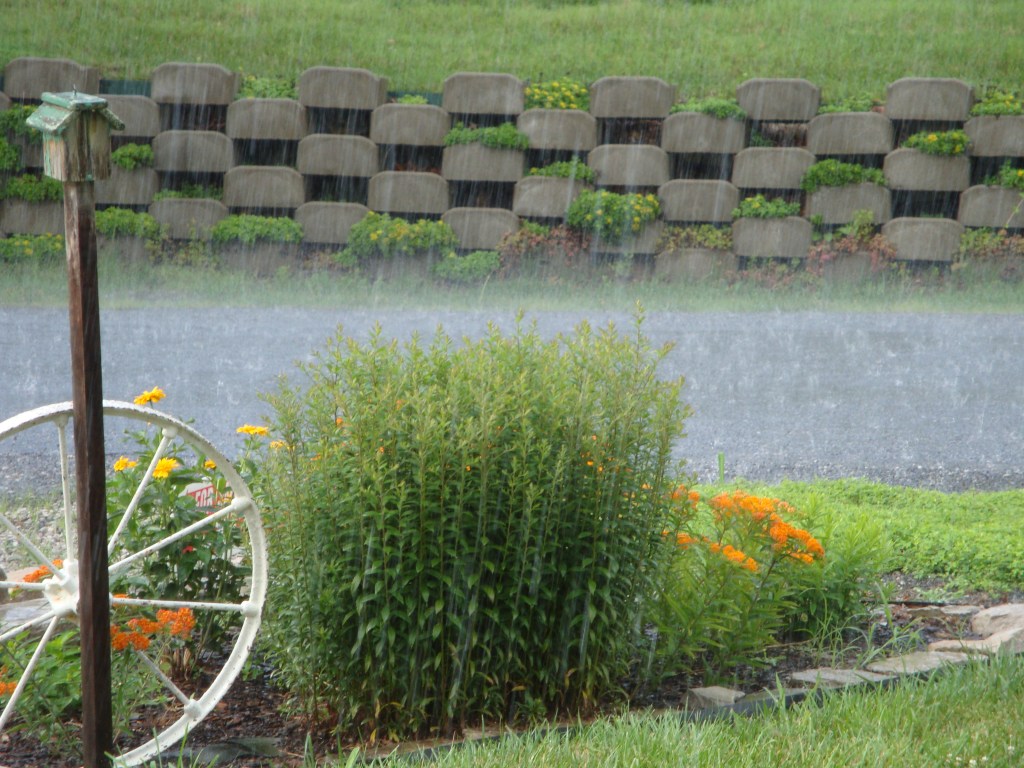
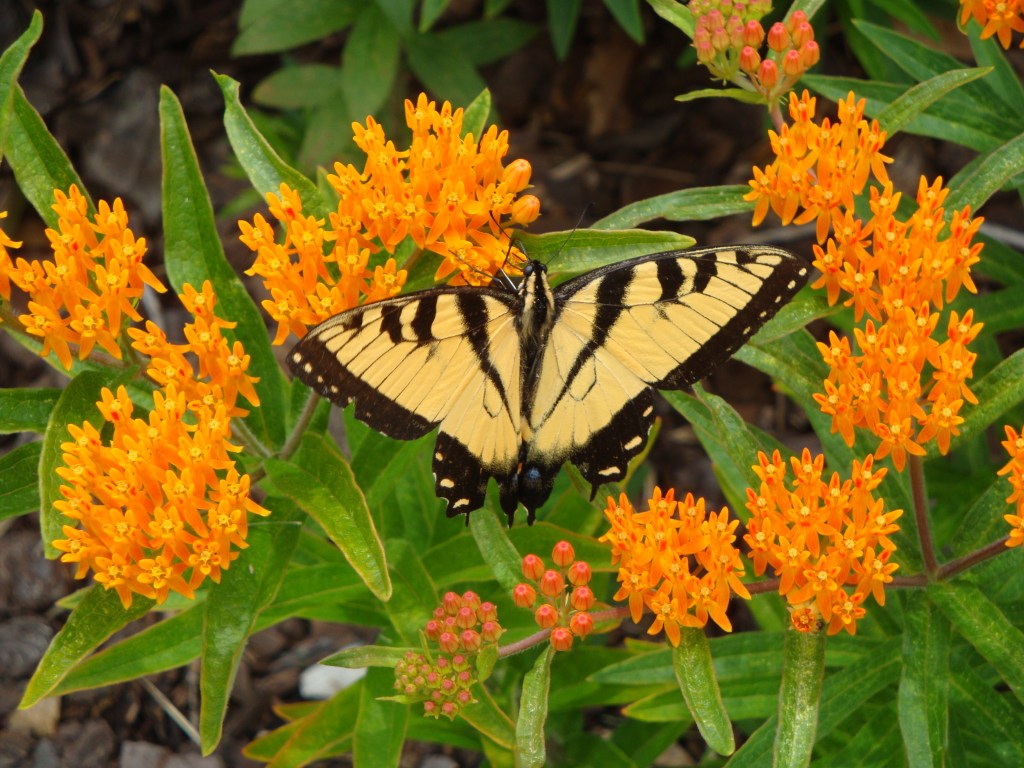
Butterflies and bees (pollinators) are connected to certain plants that are connected to certain amounts of rain. I’m repeatedly reading that the eastern half of the US is getting wetter and the west drier. Precipitation is becoming more extreme and patterns are changing in the US, Europe, and elsewhere. Both impact farmers.
Global warming is leading to higher temperatures on Earth. Higher temperatures result in more evaporation. Warm air holds more moisture than cold. With more moisture in the air, is it any surprise that hurricanes and storms drop more rainfall? Is it any surprise that 26 inches of rain fell on Fort Lauderdale in one day during the spring of 2023? That rain did not involve a hurricane. Other communities, including those in eastern Kentucky and Texas, have suffered devastating flashfloods from intense rainfall events.
Even with these facts, our leaders continue to support development in flood plains and other risky areas. But why not? When a disaster happens, flood insurance will cover part of the damages and taxpayers the rest. Right? Maybe no. As of October 2023, the National Flood insurance program was $20.5 BILLION IN DEBT. How’s that working for us? Developers made their money but leave others to pay. Does that seem fair? How about good development? Taxpayers don’t need more burden.
The southwestern part of the US is getting drier. Around the world, deserts are getting bigger. The little water that does exist in these areas is evaporating too. That means drier forests and desert vegetation. Will there be enough water for a US desert shrub that contains natural rubber–a domestic, renewable rubber that a major tire maker hopes to use? Fires in the now drier deserts and western forests are reaching the catastrophic stage more frequently. It doesn’t matter if they are started by lightning strikes, downed power lines, or an arsonist.
One change can trigger others with unexpected (unintended) consequences. That isn’t an opinion. It’s Secret #4 – the Law of Unintended Consequences. Secret #5 -the Law of Tolerance reminds us that there are limits to how much change plants and animals can tolerate. This law of nature is a Goldilocks thing. Too much rain for plants is bad as it can cause root crops, such as potatoes and carrots, to rot in the ground. Too little rain is bad. As droughts increase, grain crops may survive but the bushels per acre drop. That hits farmers right in the pocketbook. To stay in business, they have to pass the cost on to consumers. So, less rainfall hits our pocketbook too. Plus, heat stroke is a growing threat to farmers, farm workers, carpenters, and to linemen who restore electric after storms. Even teens playing football and other outdoor sports are struggling in the heat.
One change can trigger others. Our lands and oceans are warming. Warmer water holds less oxygen. Prove it by setting a pan outside on a warm day and filling it with cold water from your kitchen faucet. Wait a few hours, then go look at it. All those bubbles show oxygen is leaving the water. Sections of the Gulf of Mexico, North Sea and other major fishing zones have warmed and lost so much oxygen, they are now referred to as hypoxic or “dead” zones.” With 50 percent of the world’s protein coming from seafood, it’s good to remember that fish, lobsters, and shrimp gotta breathe too.

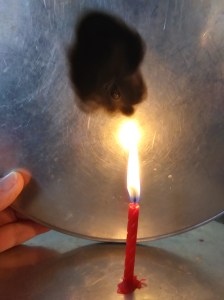
Together, three of the laws mentioned above explain why fossil fuels, which contain sulfur, carbon, mercury, etc. are a problem. Every product made from petroleum, be it gasoline or birthday candles, inherit those substances like we inherit the color of our eyes. We can prove they inherit carbon, and it doesn’t “go away” or disappear, by holding a metal pan in a candle flame. The candle may disappear as it burns down, but the carbon that was inside of it stays with us.
Look at the black spot. It’s carbon soot from one tiny candle. One. Think about how much soot, carbon dioxide, and other greenhouse gases are spewed into the air every day by 1.4 billion cars. Repeat, 1.4 BILLION cars spewing out dangerous carbon pollution. That’s not all. Add carbon pollution from trucks, planes, trains, buses, barges, cargo and cruise ships, fossil fuel power plants, gas furnaces, and ranges/stoves, etc. Think we don’t have a problem? Think again. The increase in greenhouse gases, which include carbon dioxide, triggered our climate crisis. In terms of climate records, we now have 14,000 years of tree ring data, 300,000 of years of data from ocean mud, 500,000 years of data from cave stalactites and stalagmites, 800,000 years of ice core data, and 3,000,000 (3 million) years of records in the layers of carbonate rock (e.g., limestone) that provide climate change evidence. All act like ancient records that show what happens to Earth’s temperature as carbon dioxide and other greenhouse gases rise and fall. By failing to acknowledge the ideas of “inherit” and “everything goes somewhere,” we keep repeating the same mistakes. Now that we know, there are no more excuses, no more foot dragging. We have to act now. Now.
Special note, for the tiny percent of people who think there is warming, but it is related to coming out of the ice age, they ignore that humans are having an impact too. Ice ages happen as part of a regular cycle. The rapid climate warming we have been experiencing since the industrial revolution can only be explained by what we humans are doing by dumping enormous amounts of carbon to the atmosphere. It’s like making spaghetti sauce. A little garlic is good. But you don’t want everyone dumping lots more in the pot. For those who point the finger at volcanoes, they contribute less than one percent of the carbon in the atmosphere. How can scientists say that? Carbon from volcanoes has a different chemical “fingerprint” than carbon from fossil fuels. It’s okay to have doubts. But it is time to dismiss many of them.
There is good news. We’ve solved a lot of water and air pollution problems. We stopped acid precipitation (rain) and have made real progress in fixing the ozone hole. We’ve slowed soil erosion and are trying to protect groundwater. We are saving (protecting) seeds in climate-controlled vaults. In short, we’ve made good progress. If we care about the type of future young people will have, we must make more progress and we cannot delay one minute more.
Summary
Earth’s Forgotten Secrets highlights almost every topic that’s been in the news and some that haven’t. And yes, you can understand them. Secrets does point a few well-deserved fingers at deliberate efforts to distract and mislead which continue to this day (citations provided in the eBook). Most importantly, the book provides details on how to take action in your community. You can read the 135 pages quickly. The remaining pages consist of citations, a detailed glossary, and an index.
Read the eBook because you care about your family and young people everywhere. If you don’t have two hours, give it to a teen to read and then listen to what they have to say. Their future depends on our willingness to fix things. Next, encourage others, including your representatives, to read Earth’s Forgotten Secrets. Tell them it’s a nonpolitical, nonnegotiable owner’s manual for the planet. Remind them that 92 percent of Americans say we have a climate problem. Numbers matter to our representatives. A lot. Now you know why resolving climate and biodiversity issues MUST be a priority in every upcoming election.
| Separate problems? Or variations of the same mistake? Thinking about the Earth Secrets can help us anticipate and prevent problems. NOTE: efforts are underway in the US government to fire climate scientists and scrub references to climate change, as if somehow it will go away. It won’t. Given this scrubbing, I cannot promise the links I provide remain valid. Ask your represent-atives to be heroes, not zeroes. Climate should not be political issue. | |
| Ignoring these Earth Secrets > created the problems below. | #7-Everything comes from somewhere and goes somewhere. #3-All things are connected. #4-One change triggers others and can cause unintended problems. #5-There are limits to how much change living things can tolerate. |
| Acid precipitation (rain) | Sulfur, released while burning coal, went into the atmosphere. It mixed with rain and snow, making them acidic. This acid precipitation fell back to Earth where it harmed lakes (fish) and forests (trees). Effects of Acid Rain | US EPA |
| Ozone hole | Chemicals (CFCs) in spray cans went into the atmosphere and broke apart ozone molecules which protect us, plants, and animals from UVB radiation. Cancer and cataracts increased. Plankton (Earth’s main oxygen factory) were harmed. Health and Environmental Effects of Ozone Layer Depletion | US EPA |
| Lead poisoning | Lead was added to paint to make it dry and look better. It was added to plastics to make them softer. Burning leaded gasoline sent lead into the atmosphere. Breathing lead in and/or absorbing it through the skin causes brain damage and harm to unborn children. Learn about Lead | US EPA |
| Mercury poisoning | In Japan, wastewater containing mercury dumped by an industry into Minamata Bay went into the food chain and into the bodies of people who ate contaminated fish. Some of their children were born with unbelievably severe birth defects. Mercury | US EPA |
| Climate change | Carbon, and other greenhouse gases, from burning fossil fuels also went into the atmosphere. Like a blanket, this pollution is warming the air, lakes, and oceans. This causes oxygen in water to drop. Lakes and oceans become more acidic, eating away at the shells of oysters, clams, scallops, and harming young crabs. Acidic water harms fish too. Warming melts polar ice raising sea levels and flooding coastal homes. Melting permafrost releases viruses and methane, another dangerous greenhouse (warming) gas. Winds and ocean currents warm, precipitation levels change, etc. Hurricanes and storms drop more rain. https://www.space.com/what-is-climate-change-explained |
| Solutions | Cleaning up air and water pollution greatly reduced harmful substances. Lead in gas was replaced with renewable ethanol. Safer propellants in spray cans are allowing the ozone hole to heal. We need to phase out fossil fuels. In addition, we must think about where new chemicals, substances in new products, and new energy resources will go and the changes they might trigger BEFORE using them. Research green chemistry. |
Note: The whole purpose of environmental impact studies is to anticipate problems before they occur.
| Ignoring these Earth Secrets > created the problems below. | ES#2-Save biodiversity. ES#4–One change triggers others which can cause unintended consequences/problems. |
| Deforestation | Fewer trees mean more sunshine and more evaporation. With more evaporation, areas dry out. That messes up the water and oxygen cycles. It changes where precipitation falls which impacts our food supply. (Remember: you can’t do just one thing.) |
| Wetland destruction | When wetlands are filled or drained, there are fewer places for water to soak in and recharge (refill) groundwater–the source for more than 50% of our drinking and irrigation water. Valuable habitat, including seafood nurseries, is lost. Food webs are impacted. Repeat: drinking water and food supplies harmed! |
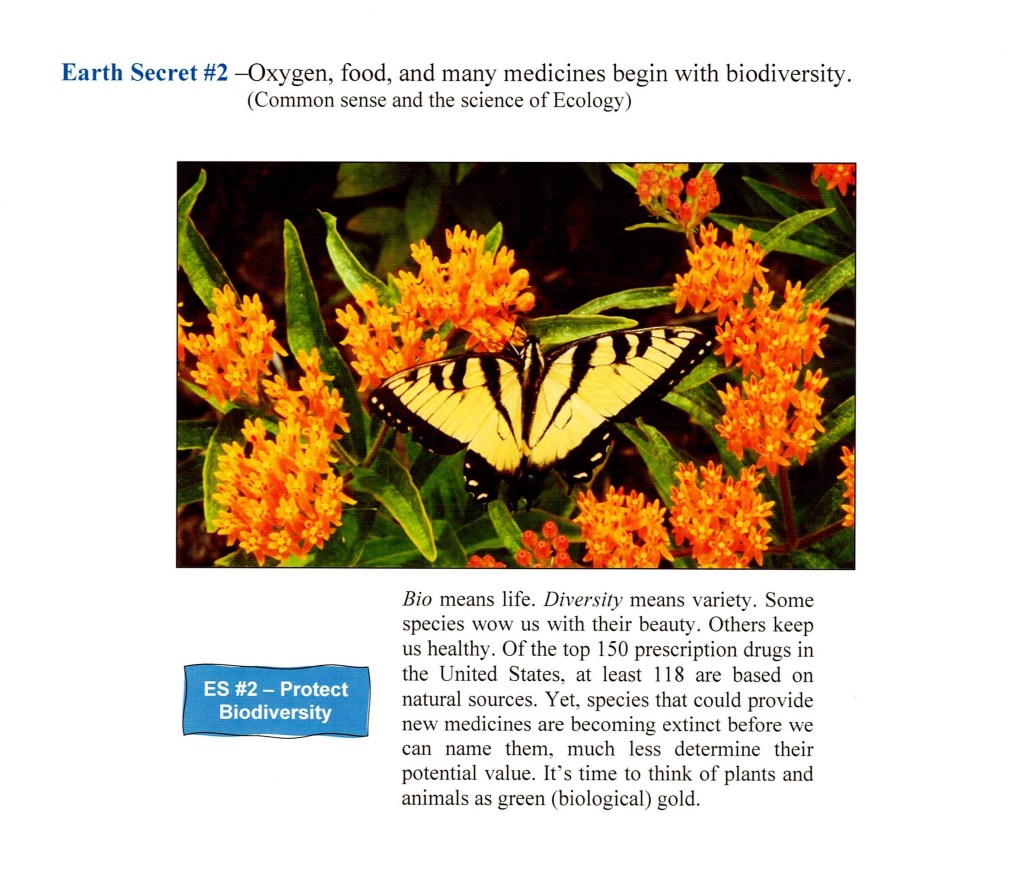
| Habitat fragmentation (clearing forests or vegetation along coasts for homes and roads) | Biodiversity is lost. Pollinators are lost. Food webs (supply chains) are impacted because over 30% of crops depend on pollinators. Few know that 90% of all plants on Earth (which includes trees) have flowers and 80% of those depend on pollinators. That means pollinators are essential to our food, water, and our oxygen supply. Remember: we are a part of nature, not better than. |
| Loss of species | Light pollution, deforestation, wetland destruction, habitat fragmentation, climate change, ocean acidification, and decreasing oxygen levels in water, all harm species. As for light pollution, we don’t drive or walk in the sky. We don’t need light up there. We need it on the ground. The right light fixture can make that happen. BOTH – dark skies for pollinators and wildlife and light so we can see – but light on the ground. |
| Energy related problems | ES#6-It takes energy to get energy. Every time we use energy, most is wasted. The greenhouse gases created by burning fossil fuels are direct threat to our food, oxygen, and water supplies. |
| Energy efficiency | Only 10% of the electricity used by the old incandescent bulbs made light. The other 90% made the bulb hot. Only 30-35% (at best) of gasoline makes turns the car’s wheels. The other 65-70% makes the engine hot. That means we are throwing away $6.50 – $7.00 for every $10.00 we spend filling our cars. LEDs are replacing incandescent bulbs (which will no longer be sold). With electric vehicles improving, we are headed in a much better direction. Some $8.00 to $9.00 of your hard-earned money turns the wheels on electric vehicles. Recharge times are as little as 20 minutes and 250-300 range is not uncommon. By the way, at least one “big box” store is adding EV charging stations in their parking lots so your electric vehicles can recharge while you shop = Win-Win! |
| Solutions | Reduce use of fossil fuels to slow climate change and reduce ocean acidification, deforestation, and habitat destruction. Continue research on electric vehicles. Go very slow on expensive hydrogen as a fuel. Make sure it doesn’t destroy cleaning molecules (hydroxyls) that limit climate damaging methane in the atmosphere. Use LED bulbs. To protect nocturnal pollinators, limit light pollution by using fixtures that shine downward…we don’t walk or drive in the sky, we don’t need light up there! Shine it on the ground! Win-Win! Remember: the eBook is free. |
Photo credits – Astronaut: https://www.hippopx.com/en/astronaut-space-suit-space-nasa-aerospace-outer-space-space-walk-189470 – Man in the mountains: Drlukitas, https://commons.wikimedia.org/ wiki/File:Forest_path_to_the_sun.jpg – flower garden, butterfly, candle soot, and oxygen bubbles in pan: Susan Barker
 Earth's Forgotten Secrets